Read the story: Bringing the Buddha of a village hall home ›
Notes on the object
In BE 2543 (2000), Wat Khoi Tai cast replicas of the principal Buddha of its Vihara so that the faithful could keep them at home – like bringing a part of the temple into one's house. The front of the base bears a cast plaque in Thai "พุทธประธาน พระวิหาร" (principal Buddha of the Vihara), and the back a name plate "วัดข่อยใต้ ๔๓" – Wat Khoi Tai, year (25)43. These two plaques, cast in one piece with the statue, confirm that it came from the temple's own ceremony.
Posture
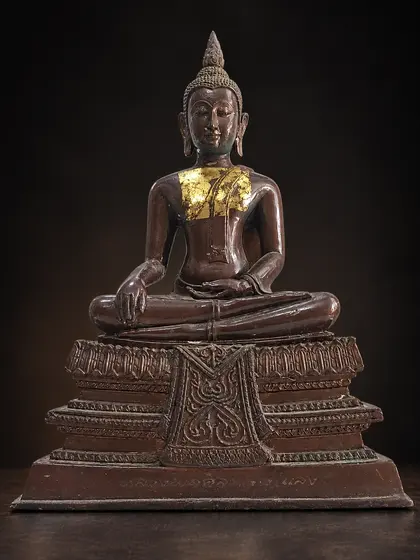
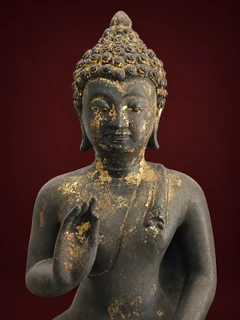
The Buddha sits in full lotus, the right hand over the knee touching the earth – the gesture of Subduing Mara (Maravijaya), the moment he overcame every obstacle and attained enlightenment. The left hand rests palm up in the lap. A tall flame-shaped ushnisha, small hair curls, arched brows and a fine nose mark the Sukhothai style, regarded as the most graceful and beautiful school of Thai art. A long robe flap falls from the left shoulder to the navel, its end forked. The whole figure is covered in lustrous gold, on a sturdy round base.
Meaning
The gesture of Subduing Mara symbolises the strength to overcome difficulty and keeps the home at peace. The principal Vihara Buddha is the image of everyday protection – kept at home for a calm household, steady work and smooth affairs.