Read the story: “The Temple of the Calf” and the Buddha of the Three Marks ›
Notes on the object
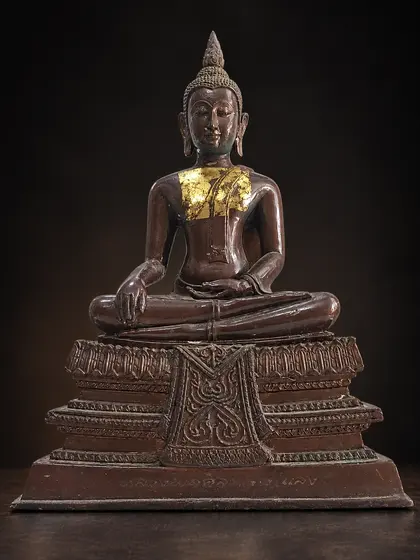
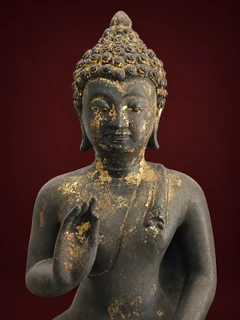
This statue was cast in the likeness of Luang Pho Trailak so that the faithful could keep it at home. The Buddha sits in full lotus, hands resting one upon the other in meditation, the face serene with the faintest smile. The hair curls are small and even, the ushnisha pointed like a lotus bud. The robe falls over the left shoulder, its end finely forked. The double lotus throne has full, rounded petals and sits on a sturdy bevelled base. The front of the base carries a bronze name plate inscribed in Thai "หลวงพ่อไตรลักษณ์ วัดประชาบำรุง บางขุนเทียน" (Luang Pho Trailak – Wat Pracha Bamrung – Bang Khun Thian), confirming that the statue came from the temple itself.
What captivates collectors of antique statues in this piece is its patina. The Thai call it "phiu hing" – devotional patina: a surface that forms naturally over many decades of veneration, through incense smoke and the touch of the hands of those who pay respect. The ground is a dark black bronze, with warm red bronze showing through at the chest, neck and arms, touched with the green of time. It is something no chemical can fake in a few months.
Material
Antique (black) bronze. In the time of the old masters, bronze for statues was rarely new metal; it was gathered from old bells and objects offered by the faithful, melted and only then cast – which is why the colour is so deep and full of character, quite unlike today's industrial bronze.
Date
No document records the exact casting. Based on the temple's history (boundary consecration in 2514, with the ordination hall built afterwards) and the statue's devotional patina, it is estimated to have been cast around BE 2515–2525 (the 1970s). The statue measures lap 5 inches – a size Thai collectors consider rare for this temple's images.
Meaning
The meditating Buddha stands for stillness and wisdom. Kept at home, the statue is a daily reminder to keep the mind calm, to slow down, to keep harmony in the family and steadiness in work.