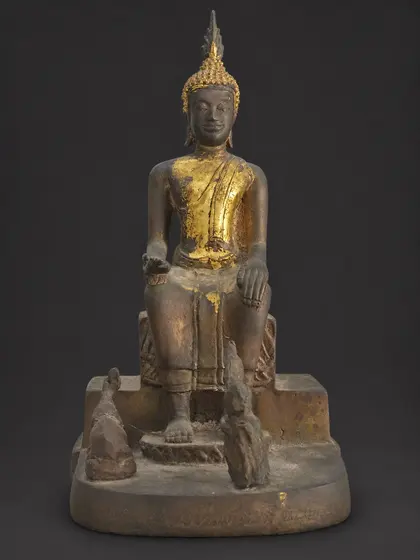
One rains retreat, the Buddha left the community of monks and went into the Palelai forest to stay alone.
The one who attended him throughout that season was not a monk, but a great elephant. Each morning the elephant drew water with its trunk, broke branches to sweep the path, and gathered fruit to offer.
A monkey in the forest saw this and wished to do something good as well. It climbed a tree, took a honeycomb, and offered it to the Buddha with both hands.
From this story the Thai created a very particular kind of image: the Buddha seated on a stone throne with both legs lowered, the elephant and monkey kneeling below with their offerings. They call it the Pa Lelai posture.
The most famous Pa Lelai image in Thailand is Luang Pho To at Wat Pa Lelai, Suphanburi Province. He is more than 23 metres tall, the height of an eight-storey building. The Thai say that to come to Suphanburi without paying respect to Luang Pho To is not to have come to Suphanburi at all.
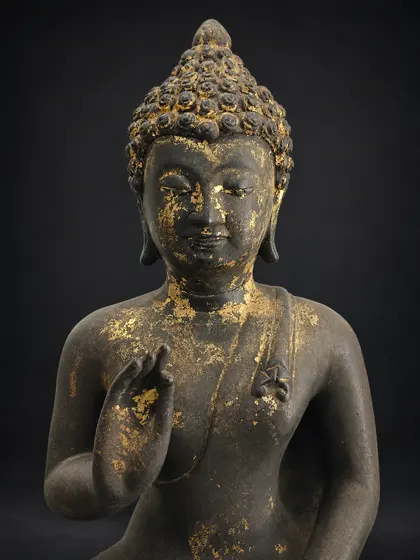
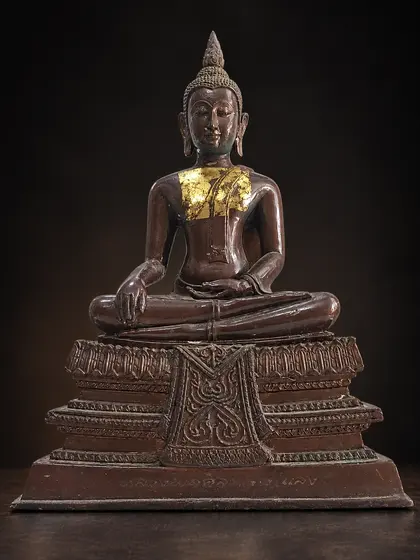
In the Buddhist year 2514 (1971), a series of small statues was cast in the likeness of Luang Pho To for the faithful to take home. The statue at Tịnh Các is one of them.
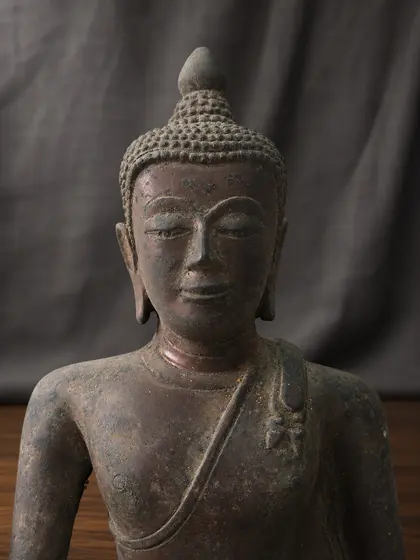
Look closely at his feet: on the left is the elephant, on the right the monkey, still kneeling in offering as they have for three thousand years. The gilding on his face, chest and feet has worn with more than half a century, revealing the deep brown antique bronze.
The story of the Palelai forest teaches something simple: sincerity need not be grand. An elephant sweeping a path, a monkey offering honey, is enough to make merit.
If you feel an affinity with it, please message Tịnh Các on Zalo for further photographs, or arrange a visit in Hanoi.
Luang Pho To in the Pa Lelai Posture – Wat Pa Lelai (Suphanburi), 1971
Wat Pa Lelai Worawihan – Suphanburi Province, Thailand · BE 2514 (1971)